Monday, May 31, 2010

My Response To An I-69 Supporter


After my recent Courier & Press article calling for Indiana to "Scrap I-69," and build high speed rail instead, there was a response written to the C & P from a Mr. Steve Schaefer from "Hoosier Voices for I-69." The article DID NOT say I-69 should be built over high speed rail because it's 1. cheaper 2. faster 3. safer 4. a more reliable form of transportation, or 5. a better form of transportation for the future. Why? Because he simply cannot. The following is a rebuttal article I have sent to the C & P in order to keep the record straight that high speed rail is indeed the proper system to implement...

In an attempt to allow space for everyone to get their opinion heard, I usually don’t write rebuttals. However, I felt compelled to answer Steve Schaefer’s article that was in response to my article about scrapping I-69 because I feel that Mr. Schaefer has a complete lack of knowledge about the benefits of replacing I-69 with high speed rail.

Mr. Schaefer did a great job dodging the facts that high speed rail will not need to destroy massive amounts of farmland to be built, it will not rely on the oil industry for transportation, and it will cost much less than I-69.
Mr. Schaefer further displays his lack of knowledge about high speed rail by stating “The likelihood of stations at every community along the route would defeat the overall purpose of a more efficient transportation system and would not provide the direct access for the flow of traffic and commerce.” High Speed rail will have side tracks called spurs that will divert local traffic away from express traffic. Even if there was just one track, high speed rail travels at speeds of 220-375 mph meaning that you could stop at every important town between here and Indianapolis and still beat an auto. Furthermore, INDOT has already taken out several exits along I-69 in order to cut costs which will further devalue this road.
Another problem I have with Schaefer’s article is his comment that “It is estimated that over 47,000 new jobs are created for every $1 billion invested in transportation infrastructure. That alone should convince any opponent that this highway is about job creation and should be a priority during these strained economic times.” Does Mr. Schaefer not realize that high speed rail is infrastructure too? Does he not realize that I-69 will only create 4,600 permanent jobs? In contrast, Ohio’s high speed rail is projected to create 11,000 permanent jobs ($6-$9 billion private investment) and California’s is expected to create nearly 450,000! Also, which would you rather Evansville be: A huge truck stop or a crossroads of America rail center?

Lastly, Mr. Schaefer said that my article was “A slap in the face,” to I-69 supporters. Well, I don’t know about you, but I’m tired of taking road trips and having my car lock up when a train would alleviate that problem. I’m tired of dealing with the BMV and insurance companies, and I’m sick of seeing crosses on the side of the road because the auto claims over 40,000 people a year. High speed rail erases all of these problems which are why it is the future. Google Personal Rapid Transit, the Interstate Traveler Project, and Maglev Rail and you will see how superior rail technology is.

I encourage everyone to write to this paper and your elected officials to demand high speed rail.


The fact is... We are at a crucial point in Evansville's history where we can either A. Catch- Up to the rest of the U.S or B. Remain 40-50 years behind the rest of the U.S. I hope you will take some time out of your busy schedule to write to your legislators and write to the Courier and Press to tell them... Enough is Enough! Evansville needs a cutting edge form of transportation just like the rest of the U.S is scheduled to receive. It is time to scrap the outmoded I-69 project and build high speed rail where we can ship goods faster, create more jobs, eliminate the crosses on the roads, reduce global emissions, and save a few pennies all at the same time.

Sunday, May 16, 2010

My 3 Articles to the Courier & Press

In an effort to get my ideas out in the public for consideration and to further improving the city of Evansville, I written a few articles to the Evansville Courier & Press over the past 8 months. Here they are....

JORDAN BAER

Oct 11, 2009

SPECIAL TO THE COURIER & PRESS

I'm tired of it all. I'm tired of high taxes, jobs leaving Evansville, a vacant downtown, a terrible transportation infrastructure and a lack of things to do.

I've gone off to college, graduated, and have come back only to see the same city with no new opportunities available. That is unacceptable. In the past few decades, not only have many projects failed to come to fruition like the downtown ballpark, but many great landmarks have been demolished as well. Gone are the Old Sterling Brewery, the Orr building and the L&N train depot. In other words, I'd rather the city have done nothing at all than what it ended up doing.

The most disappointing thing about it is the unrelenting opposition displayed by those who seem hellbent on preventing progress at all costs.

Now that the city has finally taken a step forward with an arena downtown, critics have decided to blame every problem they can on it, whether it be sewers, schools or even a pothole in the road. Even though Mayor Jonathan Weinzapfel has said countless times that no taxes outside of the TIF district downtown will be used, critics still refuse to accept the reality that they will not be responsible for the financing.

If Evansville has any desire to improve itself and move up into the next echelon of great American cities, it must ignore these short-sighted anti-progressives who are in the minority despite their rants.

To those who disagree I have two simple questions: "What is your plan? What is your solution?"

It is easy to oppose something, but tell me what better plan do you have for Evansville.

I have formulated several ideas that I feel the city should consider. My ideas are:

n Redig as much of the old Wabash & Erie Canal as possible: Rebuilding the historical canal in Evansville would be effective in attracting visitors as well as historians to the downtown. The city should look to San Antonio, Indianapolis, and Oklahoma City for how to properly build a river walk. Around it, there should be a walkway with shops, restaurants, condos, and lofts that would overlook the water. On the water, water taxis would transport tourists up and down the canal.

n Establish a slack water port in the Howell rail yards district: Evansville has a good amount of businesses that use the Ohio River to transport goods. With a slack water port in the Howell Yards, Evansville would have a formal shipping district with plenty of land to attract more businesses to the town. By moving Mulzer Crushed Stone and the businesses west of the Ohio Street bridge, Evansville would have more land downtown to develop an entertainment district.

n Move the LST to the Mead Johnson Terminal and open a World War II museum in the building: Evansville played an important role in building airplanes and ships during World War II. It's time to recognize this great history, and a World War II museum coupled with the LST would be yet another great tourist draw to downtown.

n Establish a Riverwalk on Pigeon Creek: Just like the Wabash & Erie Canal, Pigeon Creek is a great place to build a tourist-drawing river walk. It should be designed just like the canal, maybe even connecting to it. Green zones would have to be mandated on the creek in order to ensure that some parts of the creek are preserved.

n Build a ballpark, marina, and a ballpark village on the Mulzer Crushed Stone site: Design the ballpark in a manner similar to PNC Park in Pittsburgh and AT&T Park in San Francisco where baseballs can fly out into the water and fans can kayak in the river outside the ballpark with a view of the skyline down left field.

n Build a high speed rail station and tracks in downtown Evansville: President Obama recently allocated $8 billion to begin implementing a national high speed rail system where trains will eventually travel at speeds over 200 mph. One route already being discussed is St. Louis to Louisville. Evansville must seize this opportunity to bring travelers downtown by setting the rail and station downtown.

n Establish a personal rapid transit system in downtown: PRT is unique and would work perfectly for Downtown. It is effective in Morgantown, W, Va. and it would successfully move people across Downtown quickly and efficiently.

n Eliminate all building height restrictions and build a high-rise public high school: It makes no sense to encourage businesses to move downtown when the government is setting height restrictions and putting its high schools away from downtown. The Evansville Vanderburgh School Corporation should construct a high-rise building complex that would combine as many local high schools as possible. It would save on building costs, encourage downtown development and would not tie up traffic on the weekends for the entertainment district. I would pay for this by selling the existing buildings (Keep the fields and teams intact, though) and sell naming rights to the building.

n Encourage small businesses to build around Bosse Field and Main Street; Cooperstown, N.Y. is a great baseball town that is deeply entrenched in baseball history.

Bosse Field is currently the third oldest ballpark in the United States. Evansville should take advantage of this history by establishing a ballpark village around Bosse Field and all the way down historic Main Street.

I believe that there are many great ideas for Evansville that would bring jobs, entertainment, and excitement to the river city.

Evansville must be creative in funding projects like these. I would recommend reallocating 1 percent of the sales tax like Oklahoma City, reallocating portions of the gasoline tax to rail and reducing tax burdens on downtown developers.

If Evansville does this, I believe its future is bright.

Jordan Baer of Evansville is a recent graduate of the University of Kentucky with a degree in management and marketing and an interest in the sports management field.

*****************************************************************************

IN RESPONSE: Windmill monument would draw tourists
JORDAN BAER SPECIAL TO THE COURIER & PRESS
Posted February 20, 2010 at midnight

As I read Joe Wallace's commentary on Feb. 7, l I can't help but agree with him that now is the time to tackle Evansville's biggest problems. Taxes, lack of funding for fire coverage, and a public school model that is beginning to run its course economically are just a few problems that have the local townspeople up in arms.

These challenges may seem insurmountable, but I have a few solutions that I believe can turn these liabilities into assets. Here is what I propose:

How to provide the fire department with more funds: Recently, two fire stations in Evansville were targeted to be cut. Instead of cutting funds from other economic development projects that would help Evansville, I propose a strategy that would allow the fire department to generate funds. During my time in Lexington, Ky., I ate at a restaurant called FireHouse Subs. FireHouse Subs is a firefighter-themed restaurant created by a family with firefighters. In fact, they even have a foundation that is dedicated to providing fire departments with equipment and funds. I can't help but wonder, wouldn't a FireHouse Subs look great in the old firehouse on St. Joe? Wouldn't they look good next to the two current firehouses that are supposed to close? The city could lease the space to Firehouse Subs in exchange for a percentage of the profits. It would create jobs, economic development, maintain the historic St. Joe firehouse, and provide the Evansville Fire Department with an adequate amount of funds in order to prevent current and/or future station closings.

HHH

Build a Windmill Monument: I've been thinking that in order to make downtown Evansville a place that people will remember and want to visit, the city needs to build a skyline view monument. Obviously, the problems up front are: cost, height restrictions and creativity to build something that will make enough people want to come to Evansville to see it. I think I've come up with an idea that will satisfy.

Evansville is in a good location to be a sustainability center for Indiana and the Midwest. With this is mind, I think it would make sense for downtown to go after sustainability companies and create a center big enough to hold an area for tourists to come and see all the new products and initiatives from these companies. It would need to be an area large enough for green companies to produce products like Vectren is proposing with a solar cell center.

I would like to see a "wind monument."

This windmill would be slightly larger, so that tourists could go up in it like the Space Needle. It would have an observation deck and a restaurant. The skyline view of the monument would give Evansville a green image.

Luckily, Evansville has great wind potential and the monument could generate enough electricity to power 330 homes.

I believe that the city would have a good opportunity to bring in a private contractor to build this project, since the electricity and tourist revenue would offset the costs. Next to the monument would be Wind Plaza, where the city could put other green companies and their manufactured products and services.

HHH

Recruit companies that are willing to temporarily pay workers on the same day as work. Recently, I attended an event that showed the video "Where God Left His Shoes."

The video is about a family that struggles to survive because they can't catch a break and become desperate for money just to live on.

This happens every day in Evansville and I want to eliminate this struggle. If a family is in immediate danger of not having enough money to live on, they need to be able to go and work for a company and get paid on the same day, temporarily, until they can recover. The program could only be available to someone temporarily in order to discourage long term use.

Here's how I would pay for it: Any company in the program could pay their temporary workers a little less and/or could get a small tax credit for participating in the program.

HHH

Lower the property tax burden on local citizens: With a $200 million school budget, the Evansville Vanderburgh School Corporation needs to find alternative funding options from tax revenue.

The EVSC needs to be creative in funding all of its school operations. In Wisconsin, a public school has already begun selling naming rights to businesses. I propose the EVSC do the same.

Naming rights to rooms, hallways, buildings, cafeteria space, and school buses should be sold to any business that is not religious, political, or controversial.

Also, I believe that the EVSC should implement a dress code for its faculty with naming rights being sold to businesses who wish to put their logo on the uniforms.

Because I want to see this city realize its potential, I have compiled a list of ideas, proposals, and solutions for Evansville on my blog www.EvansvilleMovingForward.blogspot.com .

I invite you to come and view my ideas as well as bring your own ideas to the table. I believe that if we get enough people concerned — citizens like Joe Wallace — we will have a much better city.

Jordan Baer is a resident of Evansville.

**********************************************************************************

COMMUNITY COMMENT: Scrap I-69, use the money elsewhere
JORDAN BAER SPECIAL TO THE COURIER & PRESS
Posted May 12, 2010 at midnight

As I pick up the Courier & Press each day, I'm baffled at some of the projects that are being implemented in this area.

I'm anything but a NIMBY (Not In My Back Yard), but I can't see the logic in some of these ideas.

It makes no sense to me to tear down a historic venue like Roberts Stadium when a water park, a church for the Jehovah's Witnesses, or a science center would fit perfectly inside it.

I would hate to put Roberts Stadium on the same list as Tiger Stadium, Yankee Stadium, Texas Stadium, and Market Square Arena. Too many memories have been made at Roberts. My proposal: Build the baseball fields next to Garvin Park and build a Coney Island-style theme park with it.

Another example: I read where Gov. Mitch Daniels is green lighting the Interstate 69 project. As an avid believer in high-speed rail, I am firmly against this. Does Gov. Daniels know that over 40,000 Americans die every year on the roads? Does he realize how much land will be wasted on I-69? Does he know that high speed rail is faster, cleaner and safer than auto travel? Most importantly for Gov. Daniels, does he realize how much cheaper high-speed rail is than building I-69?

On average, high speed rail costs a fourth the price of building interstate highway.

In the Midwest, Ohio is building a 258 mile Cincinnati-to-Cleveland high speed rail for $1.16 billion, while Indiana is going to pay $5 billion for 142 miles of I-69 to go from Evansville to Indianapolis.

That means that I could allocate:

n $2.5 billion for high-speed rail from Indianapolis to Evansville with truck intermodal terminals along the way.

n $128 million for the arena.

n $50 million for a canal similar to the one in Indianapolis.

n $35 million for a ballpark similar to the one in Indianapolis.

n $1 million for a statue of Benjamin Bosse.

n $100 million to fix Roberts Stadium and place a water park resort there.

n $5 million to move the LST to the Port of Evansville and build a World War II museum.

n $100 million for a slack water port in the Howell rail yards.

n $150 million for a Pigeon Creek river walk and a windmill tower monument.

n $20 million to build the baseball fields in Garvin Park.

n $200 million for a Downtown school.

n $200 million for a ballpark village around Bosse Field with a manufacturing center nearby.

n $20 million for a Downtown aquarium and marina.

I could build all of this and still be way under the $5 billion it will cost to build I-69.

If I were the person in Indianapolis in charge of funding the Evansville region, I would cancel I-69 immediately. You may or may not like some of the ideas I have proposed, but I hope you will at least agree that my plan makes more sense than this.

Jordan Baer is a resident of Evansville.
Monday, May 10, 2010

Implementing a Canoe Race & Bike Race


With Thunder on the Ohio every summer on the river, the Indy 500 every spring in Indianapolis, and the Little 500 bike race in Bloomington every year, Evansville is ripe for racing on its greenway.

Luckily, Evansville has an awesome greenway that runs along pigeon creek where both a canoe race and bike race could take place.

First the canoe race:

A few weeks ago, I took a stroll down Pigeon Creek in my newly bought canoe. I went from the canoe launch area off Heidelbach Ave all way down to the Joan Marchand Bridge at the entrance to the Ohio River. With amazing views of Pigeon Creek and the success of Canoe Evansville, I can't help but feel that a canoe race down pigeon creek would be a huge success.

The date of the race would have to fall sometime in the summer perhaps the week leading up to Thunder. It would involve 2 classifications of canoes with any boat over 14'' being in the big boat category and the rest being in the small category. There would also be a category for kayaks. There would also be different age groups with the number of heats determined by the number of participants. Admission into the races would be between $10 and $20 with half the money going to the winner and the other half going to clean, fix, and maintain Pigeon Creek.

For the bike race:

Like the Little 500 held every year in Bloomington, the Evansville bike race would be open to amateurs only. Unlike the Little 500, the race would be on a greenway not on a circular race track meaning the finish line wouldn't be in the same complex as the starting line. Ideally it would be nice to start at Garvin Park and end at the Ohio River on the greenway but that is currently not possible since the trail has not been completed. Either 1. a temporary track could be layed down 2. a detour could be set up or 3. a the race would be shortened to the completed trail only.

Whatever the course, the set up would be similiar to the canoe race in the sense that admission would be between $10 and $20 with the proceeds being split and the races would be divided by age. To me, it would be a good idea to have the bike race the same week as the canoe race.

With a magnificient greenway and a call for more people to come experience the Evansville outdoors, a canoe race and a bike race on the Pigeon Creek Greenway would be a perfect addition to the Evansville calendar.

Sunday, May 9, 2010

Building on the Success of Mesker Park Zoo & Improving Mesker Drive


Over the past 5 years, the growth of Mesker Park Zoo has been phenomenal. A $15 million tropical rainforest called Amazonia has been constructed as well as a new entrance to the park. The Zoo seems pretty good right now so what should the zoo focus on moving forward?

Luckily, the zoo has an advantage over many other zoos in the fact that it has room to grow. There are very few houses between the zoo and Diamond Ave so the zoo basically has unlimited potential for growth. Why should the zoo take over that much land?

It seems like a pretty logical move, in my opinion, to expand all the way to Diamond Ave. With the zoo currenty being roughly 50 acres or so, it would be able to compete with the zoos in Cincinnati and San Diego who have land as large as 107 acres. Evansville would arguable be home to not only one of the greatest zoos in the Midwest but the whole U.S as well.

The expansion to Diamond Ave would also allow for the zoo to do each of the following...

- Bring in polar bears
- Build an even bigger rain forest
- Build a gondola sky tram ( The same as the one I proposed for downtown in an earlier post) that would go over an African Safari
- Set up a nature preserve for the trees and birds currently on the lot

I can't get over how fast Mesker Park Zoo has progressed over the last few years and I hope they will consider expanding again while they have all of this positive momentum. I do understand that money is tight since they just had to spend $15 + million on this latest expansion, but if they take things one at a time and plan effectively they will get there.

Another Mesker Park Zoo expansion is not the only vision I have for Mesker Dr. Years ago, there use to be a carnival at what is now a shelter house across the street from the entrance to the zoo. Believe it or not, it had just about anything you could imagine and it attracted children from all over. Unfortunately, it shut down and most of the rides are in Florida now.

At first, I considered proposing to put another Coney Island style permanent carnival there but have reconsidered that due to the fact that I believe a Coney Island style carnival would be served being located next to garvin park, Pigeon Creek, and hopefully some more youth baseball fields. So what would I do with the shelter house and additional land?

It is my belief that whatever is placed on that land should A. Keep the historical shelter house intact & B. Focus on children. With that in mind, I propose building a massive maze similar to the one that use to be up by French Lick and the one made out of trees in New Harmony. The shelter house would serve as the entrance with the maze taking up the rest of the land behind it. It would be relatively cheap to build and it would replace the maze in French Lick that has unfortunately been removed.


I also believe that if a downtown amphitheatre is ever built like the one I proposed earlier, the current Mesker Amphitheatre should be converted to a SeaWorld like dolphin show for the zoo.

It would be nice to drive up Mesker Park Drive and see the greatest zoo in America on my right and the biggest children's maze to my left with the old shelter house still intact. Now that would be awesome!

Thursday, May 6, 2010

Evansville Needs to Finally Build an Amphitheatre and Aquarium Downtown


Since the downtown master plan came out in 2001, two hot topic proposals have been the construction of an amphitheatre and an aquarium downtown. Unfortunately, neither of these two projects have been yet to be built but that doesn't mean there isn't great potential for them downtown.

If memory serves me correctly, the Army Corps of Engineers rejected Evansville's first proposal to build an amphitheatre next to the river. I can go on and on about how pointless it is to block a riverfront amphitheatre initiative but that's not going to accomplish much. Instead I am going to make a list of locations that I believe would make for a great outdoor amphitheatre downtown..

- Riverfront Plaza
- Sunset Park
- Casino Aztar Plaza
- The lot between the museum and the Four Freedoms Monument
- Part of Mead Johnson's parking lot

As you can see, there is plenty of opportunity for an amphitheatre downtown. I also believe there is great demand for it. Thinking longterm, I would like to use a downtown ballpark as an amphitheatre on non gamedays. Therefore, a small to medium size only amphitheatre should be built.

In regards to the aquarium: It seems like there never is enough momentum to get the aquarium over the finish line. It amazes me that a town so close to the Ohio River does not have an aquarium. It's like Los Angeles not having a NFL team.

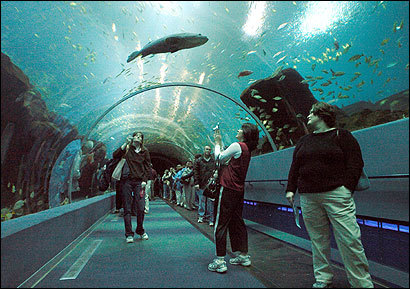
The perfect location for the aquarium is by far and away the open lot that was originally suppose to be a ballpark next to the old Jillians and Casino Aztar. The lot is plenty big enough for a massive aquarium the size of the one in Atlanta, and it's in an excellent location to construct an underground tunnel that would go beneath the Ohio River so that tourists can see all the fish in the Ohio River. It would be an overwhelming success, we just need to financial and political support for it.

Monday, May 3, 2010

Bringing the First Sears Building Back to Life


Evansville is blessed to be the city where the first Sears retail outlet located outside of a mail order city was erected.

Located at the corner of 4th & Sycamore Streets, Sears first opened its doors in building in 1925 but ended up closing their doors in 1975. The building has since been renovated and placed on the National Register of Historic Places.

Today the building sits mostly empty but its potential is vast. In a previous post, I talked about the need to convert the Old Greyhound Bus Station lot and the two other empty lots next to it into a mall with a museum alley next to it. This plan is very similar to Circle Centre Mall in Indianapolis. If implemented, this plan would improve downtown Evansville significantly. The plan would also help revitalize the Sears building too.

My vision for the Sears Building is this:

1. Remodel the building

2. Add a skywalk to the mall that would be constructed across the street

3. Place a Sears back in the building

4. Open up a small Sears museum next to the Sears retail store

Assuming a mall would be built across the street, this vision would do two things. It would reinforce the idea of retail in that area, and it would reinforce the idea of a museum alley in that area. To me, the history of having the first Sears retail outlet is just to valuable to waste.

Sunday, May 2, 2010

Building a Transportation Station Hub and a Theme at the Same Time


Sometime in the near future, Evansville is going to need to build a massive one stop transportation hub. Why? Because eventually high speed rail is coming to Evansville and it won't be just one track, it will be tracks coming from Indianapolis, Chicago, St.Louis, Cincinnati/Louisville, Nashville, and Memphis. Evansville will also be the center of I-64, 41, and I-69. This is the direct result of Evansville being in an ideal location for Midwestern and U.S travel. Indiana may be the crossroads of America, but Evansville is the epicenter of the Midwest!

In earlier posts, I talked about the need for high speed rail and the idea of placing a high speed rail station under the Old Greyhound Bus Station with a Greyhound Bus museum and a mall above it. It would be nice to have the transportation hub downtown as well, but with tracks coming from 6 different cities, it may need to be placed on the outskirts. In other words, the transportation hub (non local routes) should be built out by the airport (although I don't support expanding the airport) with a bus station and a local high speed rail station downtown (local routes) with a bus terminal and hopefully a Personal Rapid Transit terminal as well.

Determining the location and design for a project like this could make or break the future of Evansville. It needs to be built so that visitors and tourists are encouraged to go into downtown Evansville. So where would I locate the transportation hub and what design theme would I use?

Going along with the idea of placing the larger transportation hub out by the airport, I would place the hub adjacent to the current rail that runs along 41. This location is close enough to the airport to build a monorail or PRT system to transport people who just got off the airplane onto the rail system. It is also close to hotels and not too far from the CSX/Norfolk Southern crossing out by baseling road where the high speed rail tracks will probably run parallel to.

At the transportation hub, you will see rail lines coming from the 6 different main cities and a connector to the airport which has a car rental company. But wouldn't this take away from my downtown location? The answer is no. At the downtown location that I have proposed, you will see a high speed rail station for those staying local. There will also be a METS terminal, seperate tracks for dinner and excursion trains, and a link to the greenway. In the future, I would install a PRT terminal that would branch out to all four sides of Evansville. I would also leave enough room to lay down tracks for commuter trains that would go to Henderson, Owensboro, Newburgh, Gibson Co (Toyota), and a few cities in Illinois.

I believe both the local transportation center downtown as well as the regional and farther transportation hub will be a huge boom to Evansville. As said in a previous post, I would put a mall and a Greyhound Bus Station museum downtown with maybe a rail museum next to them. So what design would I implement for the larger transportation hub?
When building a hub like this, it is wise to incorporate your cities theme in it. When I was out of town a few weeks ago, I picked up a brochure for Evansville with the theme, " Where the Midwest Meets." I like this idea, I like it a lot, but there are a few themes I would like to consider as well. They are...

Evansville...
- The epicenter of America/the Midwest
- The center of Everything
- An All-American City All The Time
- Everything Comes Through Here
- A little bit of Everything

Basically, no matter which quote you plug in, it all comes back to the same idea: Evansville is in the middle of the U.S and it has a mixture of all kinds of American themes. Going off of this belief, I have formulated an idea for a design.

At the transportation hub, there should be 4 tall pillars, one representing the North, one representing the South, one representing the East, and one representing the West. Each pillar could be a huge building or a tall thin statue similar to the Washington Monument.

In the center would be the transportation hub itself with basic stores coffee shops like you would see in an airport. Behind each pillar would be land set aside for each pillars theme. In other words, the North pillar stores would have a Midwestern theme, the South pillar stores would have a Southern theme, the East pillar stores would have a Northeastern theme, and the West pillar would have a Western theme. This design would prove to tourists and visitors that Evansville does indeed have something for everyone thus they would be motivated to stay a few days here.

Only time will tell when Evansville is ready to embrace the idea of a high speed rail regional transportation hub, but hopefully, when the time is right, it will be built correctly.

Friday, April 30, 2010

Improving Burdette Park, Howell Wetlands, & Wesselman Woods

One of Evansville's greatest treasures is its vast amount of nature preserves. No matter what part of town you're in, there's always a good park or nature preserve just down the road. As a firm believer in the principles of smart growth, I like seeing some land developed while having other land left untouched depending on how much wildlife and forest occupies the land.

Three of the main parks/nature preserves in Evansville are Burdette Park, Howell Wetlands, and Wesselman Woods. All three parks have different strengths and weaknesses so I will address each one individually.

Burdette Park

In my opinion, Burdette Park does a wonderful job of getting people intertwined with nature. While at the park, you can play miniature golf, swim, play soccer or basketball, and even spend the night. Overall, it's a great park to build off of for future improvements. What do I propose......

1. Expand the swimming pool: Burdette's pool has been around for quite some time and adding a lazy river, more slides, and possible a wave pool will help keep the interest of those who are maybe tired of seeing the same thing every year.

2. Link the two lakes: Linking the two lakess at the entrance will provide for a better entrance design and will allow for small paddle boats and canoes to have enough room on the lakes.

3. Set up a bread stand: Many people who go to Burdette Park are encountered by ducks as soon as they enter the park but have no bread to feed them because they forgot. Conversely, Burdette's ducks don't have any bread on days when there are few guests. Burdette should set up a bread stand where the profits off bread sales would be invested on projects within the park. Burdette should also set up small sprinkler like devices that shoot bread or other food out onto the lake to keep the ducks from starving on days of few guests.

Howell Wetlands

The Howell Wetlands have been a pleasant addition to the Evansville community. Exotic and unique ducks, fish, and birds can be spotted most of the time at the wetlands. I find the decks that walk out on to the lakes to be the best part of the wetlands. What should the Howell Wetlands do to improve....

1. Set up a nature center similar to the one at Wesselman Woods: An interactive center would go a long way in getting more people interested in the wetlands.

2. Expand the park to the other side of Tekoppel Rd: There is plenty of forest, creeks, and wildlife on the otherside of Tekoppel Rd that would fit in good with the current Howell Wetlands. Small trails could be set up in them that would connect to the current trails.

3. Link the lakes: Like Burdette, Howell Wetlands would be much nicer and navigable if all links and ponds were connected.

Wesselman Woods

Of the three, I would have to say that the Wesselman Woods Nature Preserve is the most unique. Evansville is very lucky to have a nature preserve of that size located amongst a stadium, a mall, and a busy set of roads. Wesselman Woods also has a good recycling program, an interpretive center, baseball fields, and golf course. What does Wesselman Woods need to do to expand on its success...

1. Build chalets: Those who are interested in bird watching, nature in general, and wildlife would probably like to spend the night surrounded by the Wesselman Woods habitat.

2. Expand the nature preserve: Eliminate the golf course and plant more trees in its place. While doing this, the nature preserve should sell plaques to each tree ( the Philadelphia Eagles have done this) with the proceeds being invested at the nature preserve.

3. Schedule more events: Wesselman Woods puts on many quality events. Expanding the schedule will keep more people interested and bring in more people at the same time.

While funding may be tight, I believe that if these three parks do these 9 small things they will be even better parks.

Thursday, April 29, 2010

Taking Advantage of Evansville's Connection to the Civil War, the War of 1812, and WWI


Since the LST has arrived, it's been no secret that Evansville would be a good location for a WWII museum which I myself have talked about in a previous post. However, many locals are probably unaware of the rich history the Evansville area has had in other wars such as the Civil War, the War of 1812, and WWI.

Did you know....

* On July 18, 1862, Newburgh was the first town north of the Mason-Dixon line to be captured by the Confederate forces during the American Civil War. Colonel Adam R. Johnson, with a partisan band, crossed the Ohio River and confiscated supplies and ammunition without a shot being fired.

* On March 27, 1812, Hugh McGary, Junior, bought land for the settlement which he called McGary's Landing. In 1814, to attract more people, McGary renamed his village "Evansville" in honor of Colonel Robert Morgan Evans, an officer under then General William Henry Harrison in the War of 1812.

* At age 21, Evansville native James Bethel Gresham became the first American casualty of World War I. He is buried at Locust Hill Cemetery.
http://www.evpl.org/downloads/feelthehistory/watch.aspx?id=6

As you can see, Evansville has a rich history in several wars, not just WWII. As a result, I am in favor of a WWII museum with the LST being located on the current Port of Evansville location, but I also believe Evansville needs to make residents and tourists fully aware of its history in the three wars mentioned. So what specifically am I proposing?

One of the war tributes to Indiana veterans that has caught my attention is the Soldiers and Sailors Monument in Indianapolis. A few weeks ago, I had the opportunity to visit it and I can't get over just how great of a monument it is. At the monument, you can go to the top to look out and see all of Indianapolis, visit the gift shop, sit on the large concrete stairs, or relax next to the large water ponds at the base. Even more eye catching are the buildings that form a large circle around it. In fact, almost all of the buildings in downtown Indianapolis revolve around the "Circle Centre" plaza. Malls, restaurants, office buildings, etc have set up shop around it.

When I saw the monument it got me wondering, why can't Evansville create a monument where tourists can go up in it to view Evansville under a statue of Robert Evans sitting atop it with a museum about the three wars and a gift shop inside? The statue of Robert Evans would be overlooking his city just like William Penn does in Philadelphia ( this plan is very similar to my Benjamin Bosse statue proposal). At the base would be a monument to James Bethel Gresham.

I would also like to see a Civil War interpretive center with reenactments being staged each year with the history of Evansville and Newburgh incorporated into them.

Most importantly, Evansville has plenty of room to implement this downtown. Why not place the monument plaza behind the Civic Center, next to the Old Courthouse, or between the Four Freedoms Monument and the Evansville Museum?

Indianapolis took full advantage of its rich history in the service, will Evansville?

Wednesday, April 28, 2010

Converting Ellis Park To A NASCAR SpeedPark


http://www.nascarspeedpark.com/

Although Ellis Park isn't in the Evansville metro city limits ( O how I wish it was), it still plays a pivotal role in turning around the area. It is in a great position off of 41, it will plan a major role in converting the whole Twin Bridges area into an area where people will want to visit, and it has a lot of history.

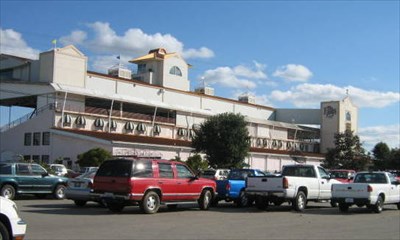
I will admit that I am no fan of horse racing. I went to several horse races in Lexington and just never understood why it still exists. It's slow/boring, it's borderline unethical on the horses, it's a dying sport, and it's not as popular as auto racing. I will take the Indy 500 over the Kentucky Derby anyday.

It seems like every year we hear that Ellis Park will be forced to close, yet somehow it is able to hold on for another year. It's time to convert to an entertainment complex that won't rely on the horse racing industry. What should be done at Ellis Park?

It seems pretty obvious to me that Evansville is a huge NASCAR town. No matter where you go, you're always walking by or standing next to someone with a shirt, hat, or jacket with their favorite driver on it. It's time Evansville took advantage of its deep love for NASCAR.

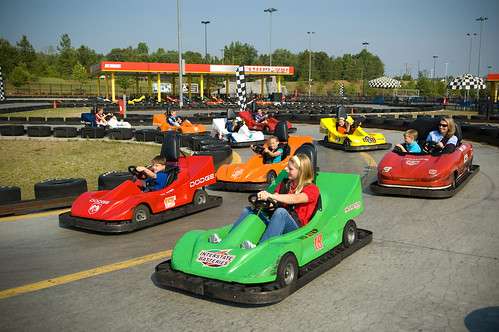
Already in five locations, NASCAR SpeedParks are a blast. At a SpeedPark, you can rock climb, play miniature golf, play video games, compete in laser tag, and race Go Karts for an affordable price. Ellis Park is a perfect place for this. The track is already there, the fan amenities are already there, and it's big enough for all the attractions a NASCAR SpeedPark would bring in with it.

I wouldn't stop there though. Since Ellis Park has quite a large amount of space, I would add one more track for a Richard Petty Driving Experience to offer rides and classes on. The track could be in the shape of a short track with high banking, a road course, or a super speedway.

Lastly, I would place a NASCAR Cafe on the site as well. A NASCAR Cafe would be keeping with the theme and would serve the area well due to the fact that there are currently no other restaurants in the area.

I can't help but feel that it is pretty obvious that a NASCAR SpeedPark offers a lot more to the region than a horse racing track, not to mention it won't be on life support each year if a gambling bill isn't passed. It's time to build a NASCAR SpeedPark on the Ellis Park site.

Tuesday, April 27, 2010

Introducing Evansville to CPT- Cable Propelled Transit


http://gondolaproject.com/

In previous posts, I talked about Evansville's need for high speed rail and PRT (Personal Rapid Transit). Another form of transportation that needs to be implemented in the Evansville metro area is CPT which stands for Cable Propelled Transit.

This link here will walk you through the technology http://gondolaproject.com/2009/11/07/basic-lesson-1-what-is-cable-propelled-transit/


Basically, CPT needs to be implemented in Evansville because...

1. It's the cheapest form of transportation

2. It's the safest form of transportation

3. It's clean & green

4. It pays for itself

In a nutshell, I argue the same points for CPT that I argue for PRT. Both are better than the car due to the fact that they are more reliable, kill less people, and cost less to build among many other things.

The thing that excites me the most about CPT is how ripe the Evansville area is for it. With its many hills and valleys, CPT could become a city defining attribute for Evansville. So what locations do I have in mind for CPT?
When implementing CPT, Evansville needs to take care of the main routes first. This entails placing CPT down the center of the Lloyd Expressway and down the center of Green River Road, 41, and First Ave. These main routes will ease traffic congestion, hopefully eliminating it completely in the future.

One radical idea that I wish Evansville would consider would be establishing a theme park across the river. Ideally, it would be nice if Kentucky would transfer the land over to Indiana like they did to downtown Evansville after the Earthquake of 1812. Evansville could then straighten the Ohio River forming an island between Kentucky and Indiana. A theme park and village would be set up on the island and guests would be taken to the island from downtown Evansville on CPT. A station could be set up at the top of almost any downtown building with cables going across the scenic Ohio River similar to what New York City does with Roosevelt Island.


Will Evansville ever give the island and CPT a chance? Only time will tell.

Monday, April 26, 2010

Build The Youth Baseball Fields @ Garvin Park, Save Roberts Stadium


This past month, there has been a proposal to demolish Roberts Stadium to build 4 youth baseball fields that will be coupled with 4 other fields to make a complex that will also have batting cages and training facilities. While the plan looks great on the surface, there are a few tweaks that I believe need to be made.

First of all, the plan is in the wrong location. As I've said in a previous post on this blog, Roberts Stadium should not be demolished. It is historic and still has great potential to be either a Jehovah Witness church or a waterpark resort. So where should the baseball fields be placed?

In a perfect world, I would place the baseball fields next to Garvin Park. I would demolish some of the dilapidated manufacturing plants next to the park and place them there. Why? There are several reasons for doing this.

1. There is more land next to Garvin: The land from Garvin Park all the way down to First Ave should be easy to obtain minus the Humane Society building. Furthermore, they would elminate the current eyesores that are down there.

2. The design would look nicer: Imagine all of the youth baseball fields next to a Coney Island development which is settled off of Pigeon Creek. That is the potential that the Garvin Park site has. Also, Garvin Park is already famous for having the third oldest baseball ballpark as well as several youth baseball fields already built. The new fields would fit in perfectly.

3. The Garvin Park plan has more potential for surrounding development: It is my belief that if a baseball complex is built next to Garvin, you will begin seeing a massive redevelopment of the area. As noted from a previous post, I see baseball museums, old time diners and shops, Coney Island attractions, and cable cars going down Main Street.

On a side note, my second location choice would be the state hospital grounds. Whether it's Garvin Park or the state hospital grounds, demolishing Roberts Stadium should not be an option.

Evansville Should Set Up A Ghost Town District


Today's entertainment industry is desperate for themes. Entertainment districts are popping up everywhere with different themes. Kansas City has the Power & Light District, New Orleans has the French Quarter, Indianapolis has the Canal District, Washington D.C has the Old Navy Yards District, and Sacramento is creating the Railyards District. To my knowledge, no urban city has taken full advantage of a western ghost town theme for an entertainment district.

Despite their distinctive qualities, very few buildings outside of theme parks have replicated the western ghost town image. Evansville could be one of the first if not the first. Even though Evansville is not west of the Mississippi, it is still prime for this theme given that it has already been named an All-American town with a mixture of everything. So where should a western ghost town be placed?

In my opinion, the Jacobsville area, which is the old housing district north of the Lloyd Expressway and east of Berry Plastics, would fit the bill perfectly. It consists of mostly low rise houses, its buildings are already aging significantly, and it is in need of something like this to revitalize itself. If Evansville could convert the Jacobsville area into something like this, it would not only create a much cleaner image for the city but it would also successfully connect downtown with the rest of the city.

What types of things would you find in Evansville's Western Ghost Town? You would see horses on carriages walking by on brick roads, you would see buildings decked in light brown signs with western script on them, and you would see retail shops that would sell western apparel such as boots, hats, and spurs.

Overall, the ghost town would be original, it would be unique, and it would bring people into the core of Evansville which is never a bad thing.

Sunday, April 25, 2010

Improving Farming and Agriculture Technology

Recently I ran across this idea and thought it would be a great idea for the Tri-State given its rich history and resources in agriculture...

http://nymag.com/news/features/30020/

Skyfarming

A Columbia professor believes that converting skyscrapers into crop farms could help reduce global warming and make New York cleaner. It’s a vision straight out of Futurama—but here’s how it might work.


By Lisa Chamberlain

Urban farming has always been a slightly quixotic endeavor. From the small animal farm that was perched on the roof of the Upper West Side’s Ansonia apartment building in the early 1900s (fresh eggs delivered by bellhop!) to community gardens threatened by real-estate development, the dream of preserving a little of the country in the city is a utopian one. But nobody has ever dreamed as big as Dr. Dickson Despommier, a professor of environmental sciences and microbiology at Columbia University, who believes that “vertical farm” skyscrapers could help fight global warming.

Imagine a cluster of 30-story towers on Governors Island or in Hudson Yards producing fruit, vegetables, and grains while also generating clean energy and purifying wastewater. Roughly 150 such buildings, Despommier estimates, could feed the entire city of New York for a year. Using current green building systems, a vertical farm could be self-sustaining and even produce a net output of clean water and energy.

Despommier began developing the vertical-farming concept six years ago (his research can be found at verticalfarm.com), and he has been contacted by scientists and venture capitalists from the Netherlands to Dubai who are interested in establishing a Center for Urban Sustainable Agriculture, either independently or within Columbia. He estimates it could take a working group of agricultural economists, architects, engineers, agronomists, and urban planners five to ten years to figure out how to marry high-tech agricultural practices with the latest sustainable building technology.

What does this have to do with climate change? The professor believes that only by allowing significant portions of the Earth’s farmland to return to forest do we have a real chance of stabilizing climate and weather patterns. Merely reducing energy consumption—the centerpiece of the proposal Al Gore recently presented to Congress—will at best slow global warming. Allowing forests to regrow where crops are now cultivated, he believes, would reduce carbon dioxide in the atmosphere as least as much as more-efficient energy consumption.

There is another reason to develop indoor farming: exploding population growth. By 2050, demographers estimate there will be an additional 3 billion people (a global total of 9.2 billion). If current farming practices are maintained, extra landmass as large as Brazil would have to be cultivated to feed them. Yet nearly all the land that can produce food is already being farmed—even without accounting for the possibility of losing more to rising sea levels and climate change (which could turn arable land into dust bowls).

Depending on the crops being grown, a single vertical farm could allow thousands of farmland acres to be permanently reforested. For the moment, these calculations remain highly speculative, but a real-life example offers a clue: After a strawberry farm in Florida was wiped out by Hurricane Andrew, the owners built a hydroponic farm. By growing strawberries indoors and stacking layers on top of each other, they now produce on one acre of land what used to require 30 acres.

Why build vertical farms in cities? Growing crops in a controlled environment has benefits: no animals to transfer disease through untreated waste; no massive crop failures as a result of weather-related disasters; less likelihood of genetically modified “rogue” strains entering the “natural” plant world. All food could be grown organically, without herbicides, pesticides, or fertilizers, eliminating agricultural runoff. And 80 percent of the world’s population will be living in urban areas by 2050. Cities already have the density and infrastructure needed to support vertical farms, and super-green skyscrapers could supply not just food but energy, creating a truly self-sustaining environment.

Like the Biosphere 2 project in Arizona, a real vertical farm will probably require a utopian philanthropist with deep pockets. In the eighties, Edward Bass spent $200 million of his own money to construct the Biosphere. A smaller and less complex vertical farm would probably cost that much to build today and could be funded by someone from a country where arable land is already in short supply, such as Japan, Iceland, or more likely Dubai. Despommier is convinced the first vertical farm will exist within fifteen years—and the irony is, oil money could very well build it.


1. The Solar Panel
Most of the vertical farm’s energy is supplied by the pellet power system (see over). This solar panel rotates to follow the sun and would drive the interior cooling system, which is used most when the sun’s heat is greatest.


2. The Wind Spire
An alternative (or a complement) to solar power, conceived by an engineering professor at Cleveland State University. Conventional windmills are too large for cities; the wind spire uses small blades to turn air upward, like a screw.


3. The Glass Panels
A clear coating of titanium oxide collects pollutants and prevents rain from beading; the rain slides down the glass, maximizing light and cleaning the pollutants. Troughs collect runoff for filtration.


4. The Control Room
The vertical-farm environment is regulated from here, allowing for year-round, 24-hour crop cultivation.


5. The Architecture
Inspired by the Capitol Records building in Hollywood. Circular design uses space most efficiently and allows maximum light into the center. Modular floors stack like poker chips for flexibility.


6. The Crops
The vertical farm could grow fruits, vegetables, grains, and even fish, poultry, and pigs. Enough, Despommier estimates, to feed 50,000 people annually.


The vertical farm doesn’t just grow crops indoors; it also generates its own power from waste and cleans up sewage water.


1. The Evapotranspiration Recovery System
Nestled inside the ceiling of each floor, its pipes collect moisture, which can be bottled and sold.


2. The Pipes
Work much like a cold bottle of Coke that “sweats” on a hot day: Super-cool fluid attracts plant water vapors, which are then collected as they drip off (similar systems are in use on a small scale). Despommier estimates that one vertical farm could capture 60 million gallons of water a year.


3. Black-Water Treatment System
Wastewater taken from the city’s sewage system is treated through a series of filters, then sterilized, yielding gray water—which is not drinkable but can be used for irrigation. (Currently, the city throws 1.4 billion gallons of treated wastewater into the rivers each day.) The Solaire building in Battery Park City already uses a system like this.


4. The Crop Picker
Monitors fruits and vegetables with an electronic eye. Current technology, called a Reflectometer, uses color detection to test ripeness.


5. The Field
Maximization of space is critical, so in this rendering there are two layers of crops (and some hanging tomatoes). If small crops are planted, there might be up to ten layers per floor.


6. The Pool
Runoff from irrigation is collected here and piped to a filtration system.


7. The Feeder
Like an ink-jet printer, this dual-purpose mechanism directs programmed amounts of water and light to individual crops.


8. The Pellet Power System
Another source of power for the vertical farm, it turns nonedible plant matter (like corn husks, for example) into fuel. Could also process waste from New York’s 18,000 restaurants.


9 to 11. The Pellets
Plant waste is processed into powder (9), then condensed into clean-burning fuel pellets (10), which become steam power (11). At least 60 pellet mills in North America already produce more than 600,000 tons of fuel annually, and a 3,400-square-foot house in Idaho uses pellets to generate its own electricity.


Copyright © 2007, New York Magazine Holdings LLC.


It would seem to me that if Evansville/Southwestern Indiana was serious about improving its vast agriculture riches, they would invest a great deal of time, money, and effort into this future technology.

Taking The Next Step To Make Reitz Bowl Even Better


There are very few football stadiums in high school football that can compare to Evansville's Reitz Bowl. With a capacity over 12,000, Reitz Bowl can be very intimidating for incoming opponents. Over the years, several changes have made Reitz Bowl what it is today. These include adding a scoredboard, artificial turf, an irrigation system, new lockers, a new fieldhouse, and a brand new sound system. So what could Reitz Bowl do to improve itself even more?

First things first, Reitz Bowl needs to see itself as not just a stadium for Reitz High School but for other teams and events as well. It is large enough for minor league football and college football. Although UE would probably never consider playing at Reitz Bowl, I believe that USI would consider it if they ever decide to add football to their athletic program. With several new minor league football leagues making attempts to get off the ground ( UFL, AAFL, National Gridiron League, & New USFL), Reitz Bowl needs to renovate to attract one of these teams. Reitz Bowl could also go after more events like Drums on the Ohio and could even loan itself out as an amphitheatre for a few days a year.

The first minor thing that needs to be added Reitz Bowl is permanent blue seats on the home side. Although the current blue painted concrete looks good, in reality, this concrete hurts some people's backs thus the need for seats. It would also make Reitz Bowl look even more professional.

Next, expansion of Reitz Bowl needs to be considered. There should be permanent seating going all the way around the stadium. Reitz Bowl is in perfect position to form a horse shoe or cookie cutter stadium design.

After that, there needs to be a few luxury boxes put in. Although it is only high school football, there is still demand for a few small and affordable luxury boxes, especially if other events are tacked on.

Lastly, I heard a rumor that a few years ago Mead Johnson Nutritionals offered to place a roof over the bowl if they would sell naming rights to them. Supposedly it was rejected due to worries over history. If true, this plan needs to be revisited. To please the people who like the name Reitz Bowl, it should be named Mead Johnson's Field at Reitz Bowl. A roof over the bowl will allow for more events to take place inside it. This, in my opinion, would make Reitz Bowl the greatest high school stadium in the nation.

Redesigning the Twin Bridges


Although they are far from downtown Evansville, the twin bridges serve as both a landmark and gateway to the Evansville region. While they provide a crucial connection for motorists, they have failed to attract tourists, pedestrians, and mass transit.

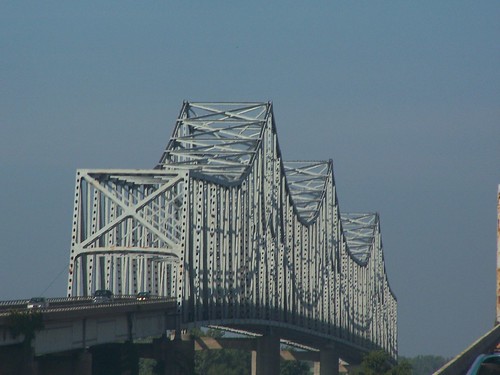
With the announcement of I-69 (I don't support it) and the planning of a national high speed rail network, it's time to give the twin towers a massive overhaul beginning with the design. Yes, the twin towers do have somewhat of a good design now but it can be much better. Designs similiar to the ones in Oklahoma City, Mackinac Island, Brooklyn, and San Francisco should be taken into account when crafting a new design.

Oklahoma City....


Mackinac Island....


Brooklyn.....


& San Francisco....


While I am not in favor yet of a specific design, there are a few things I would like to see on the new design including the incorporation of the current design into a larger design.

Regardless of what bridge design you may like, a modern day functional bridge must contain or set an area aside for a mass transit route, a pedestrian sidewalk and viewing area, and room for broken down motorists.

It would also help if the areas at the base of the bridge(s) were developed more such as the entrance to Henderson and the Ellis Park area.

There is no doubt in my mind that if the twin bridges were ever renovated to be the region's icon that they have the potential to be they would do wonders for the area. They could result in the development of a nice park, the expansion of downtown Evansville, and the unifying of Tri-State cities. One can only hope that the department of transportation will consider renovating the bridges.

Saturday, April 24, 2010

Evansville Needs To Strengthen Its Connection To Japan


If you have ever had time to wonder through downtown Evansville, you will see many things representing many cultures. Of all the things downtown, what one country would you say downtown reminds you of best? I would say Japan. Maybe it's the Pagoda, maybe it's the WWII history, maybe it's the presence of Toyota, maybe it's just me. Although I'm constantly seeing images similar to those found in Japan, I still think Evansville needs to strengthen its connection to Japan.

A few years ago, Evansville took another step forward to strengthening its connection to Japan by obtaining a sister city. Tochigi-Shi, Japan was selected as Evansville's sister city. But what other things does Evansville need to do to celebrate its resemblance to Japan.

First of all, I am a fan of attaching different cultures to different U.S cities such as Egypt to Memphis & Greece to Nashville. Attaching Japan to Evansville is definitely an idea that should be considered on the large scale.

Thinking on the small scale, Evansville needs to do several things. The first thing Evansville needs to do is place a sushi bar on the downtown riverfront. It is unfortunate that an entrepreneur hsa been unable to take advantage of the amazing looking Pagoda to establish a Japanese eatery. A sushi bar should be placed within a few blocks of the Pagoda in order to maximize effectiveness.


Another thing to consider for Evansville is the eventual construction of a Japantown. Most people have heard of a Chinatown but few are aware of the Japantowns found in cities such as San Jose and San Francisco. Although the demographics may not be there yet for a Japantown, they should be if Evansville does a better job of strengthening its connection to Japan.

Lastly, local architects need to consider Japanese style architecture in their designs for Evansville buildings. This will reinforce the Japanese image.

Overall, there will need to be changes both drastic and minor to make Evansville the " Japan of the Midwest." but I think it's up for the challenge.